Overview
The mind‑body connection is a two‑way communication system in which thoughts, emotions, and stress responses shape hormonal balance, immune function, and pain perception—key factors in women’s health. A holistic health model respects this interplay, treating the whole person—body, mind, spirit, and social context—rather than isolated symptoms. When integrated with conventional medicine, personalized strategies such as diaphragmatic breathing, mindfulness meditation, yoga, and tailored nutrition can lower cortisol, improve sleep, and support bio‑identical hormone replacement therapy. Evidence from psychoneuroimmunology and functional‑medicine research shows that these mind‑body practices reduce inflammation, enhance mood, and promote better outcomes for conditions like PCOS, perimenopause, and chronic pain. By combining evidence‑based complementary therapies (e.g., acupuncture, progressive muscle relaxation) with standard medical care, an integrative approach empowers women to actively participate in their wellness journey, fostering resilience, hormonal harmony, and long‑term vitality.
Understanding the Science of Mind‑Body Integration
 The mind‑body connection theory asserts that thoughts, emotions, and attitudes can directly shape hormone release, immune function, and inflammation, while physical states feed back to influence mental health. Modern neuroscience supports this bidirectional link: functional MRI studies have mapped a Somato‑Cognitive‑Action Network (SCAN) that ties motor‑cortex regions to autonomic control of heart rate and blood pressure, explaining why calming the body can quiet the mind. Stress activates the fight‑or‑flight response, flooding the body with cortisol and adrenaline, which suppress immunity and raise blood pressure; conversely, mindfulness, diaphragmatic breathing, yoga, and tai chi lower cortisol, improve sleep, and boost mood. Simple body‑mind exercises—4‑7‑8 breathwork, progressive muscle relaxation, and guided imagery—help release tension, enhance circulation, and speed wound healing. By integrating these evidence‑based practices, women can create a positive feedback loop where a relaxed mind supports physiological health and a healthy body reinforces emotional resilience.
Practical Mind‑Body Techniques for Daily Life
 Mind‑body therapy techniques are deliberate practices that link mental focus with physical sensation to promote healing and stress reduction. Examples include yoga, tai chi, qigong, meditation, mindfulness, guided imagery, progressive muscle relaxation, and deep‑breathing exercises. These methods are safe when taught by qualified instructors and can be tailored to women’s hormonal balance, menstrual health, and chronic pain.
Mind‑body practices engage the brain‑body network, reducing cortisol, lowering inflammation, improving sleep, and boosting immune function. Regular breath work—such as diaphragmatic, 4‑7‑8, or alternate‑nostril breathing—activates the parasympathetic system, while gentle movement like yoga or tai chi improves circulation, balance, and hormonal regulation. Relaxation techniques, including body‑scan meditation and progressive muscle relaxation, release tension and enhance emotional resilience.
Incorporating a daily routine of breathing, mindful movement, and relaxation supports overall vitality, mental clarity, and long‑term health for women seeking integrative wellness.
Naturopathic Medicine: Reality, Training, and Role
 Is naturopathic medicine real? It is a regulated U.S. profession. NDs complete a regulated four‑year four‑year graduate program, pass national exams and are licensed in 24 states. They use lifestyle counseling, nutrition, botanical medicines and other low‑risk therapies, many evidence‑based, though some (e.g., homeopathy) lack proof.
Is a naturopathic doctor a real doctor? Yes. An ND holds a doctoral‑level degree after a four‑year curriculum covering basic sciences and holistic training. NDs can diagnose, treat and, in some states, prescribe limited meds, but they are not physicians and their scope differs from MDs/DOs.
Can a naturopath diagnose celiac? An ND can order serology and interpret results, but a definitive diagnosis needs an endoscopic biopsy by a gastroenterologist.
Can naturopaths prescribe progesterone? Only where state law permits hormone prescribing (e.g., Arizona, Washington); elsewhere they cannot.
Why do some doctors distrust naturopaths? Physicians cite shorter, less standardized training, reliance on unproven modalities and occasional scope‑creep, raising safety concerns.
Integrative and Functional Medicine Services for Women
 Holistic health views every woman as an integrated whole—body, mind, emotions, social connections, and spirit—so care plans balance nutrition, movement, sleep, stress‑management and purposeful living. Functional testing (hormone panels, gut microbiome analysis, micronutrient labs) uncovers hidden imbalances that drive fatigue, mood swings, and metabolic issues, guiding personalized interventions. Bioidentical hormone replacement therapy (BHRT) uses plant‑derived hormones chemically identical to those the body produces, safely restoring endocrine harmony during menopause, perimenopause, and other life‑stage transitions. Evidence‑based supplements—omega‑3s, vitamin D, magnesium, probiotics, and adaptogens like ashwagandha—support immune function, reduce inflammation, and modulate cortisol, enhancing both physical and emotional resilience. Comprehensive wellness programs blend mind‑body practices (mindfulness, yoga, breath work), targeted nutrition, gentle movement, and counseling, empowering women to take active roles in their health. This patient‑centered, evidence‑driven approach cultivates lasting vitality, reduces chronic pain, and promotes long‑term well‑being.
Economic and Professional Landscape of Naturopathy
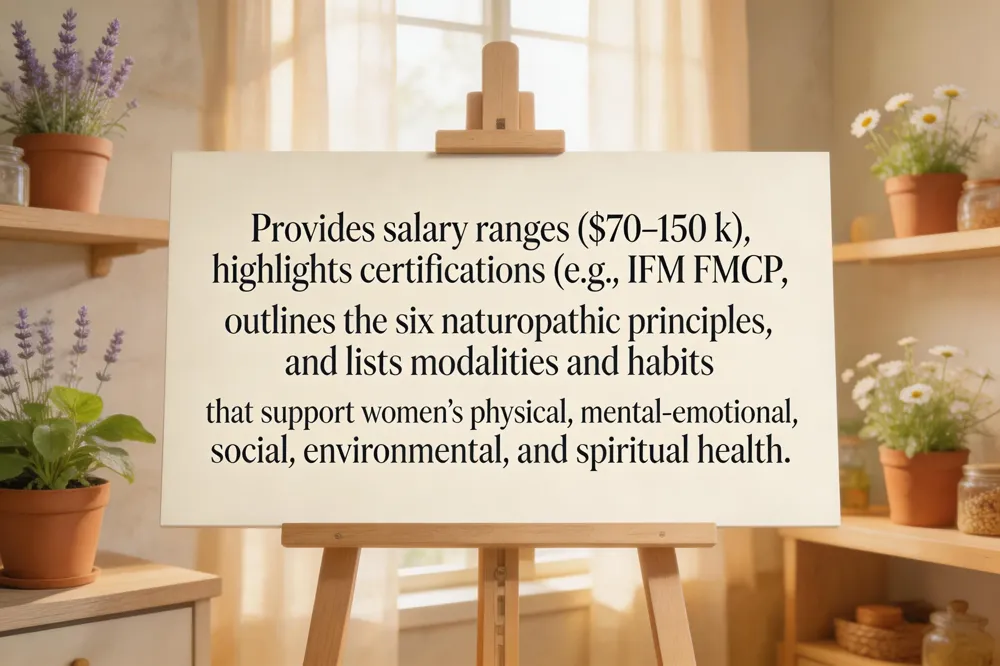 The field of naturopathic medicine offers earnings and a career path. In the United States, naturopathic doctors typically earn $70‑110 k annually; the 2020 AANMC study reported a mean of $95,600, and practitioners can exceed $150 k. Certification in integrative health and functional medicine, such as the Institute for Functional Medicine’s FMCP program, provides a toolkit that blends conventional care with nutrition, lifestyle and therapies. Holistic health includes five dimensions—physical, mental‑emotional, social, environmental and spiritual—essential for women’s health. Seven habits for a healthy mind‑body are a strong provider partnership, movement, quality sleep, emotional‑spiritual nurturing, diet, avoidance of smoking and stress‑management. Naturopathy means “natural healing,” emphasizing the body’s innate power and six guiding principles: nature, cause‑treatment, non‑harm, teacher‑role, and prevention. Modalities range from herbal medicine, homeopathy, nutritional counseling, spinal manipulation, massage, hydrotherapy and lifestyle coaching. Integrative health blends conventional medicine with therapies, while functional medicine focuses on correcting dysfunctions to support women’s health.
Final Thoughts
Empowering women to become active partners in their own care is at the heart of a mind‑body approach. By understanding that thoughts, emotions, and lifestyle choices directly shape hormonal balance, immune function, and pain perception, patients can choose personalized strategies—such as mindful breathing, gentle movement, balanced nutrition, and targeted supplementation—that reinforce health from within. Long‑term wellness emerges when these practices are woven into daily routines, reducing chronic stress, improving sleep, and supporting cardiovascular and metabolic health. Integrating conventional medicine with evidence‑based mind‑body therapies—acupuncture, yoga, cognitive‑behavioral techniques, and functional laboratory testing—creates a seamless, holistic plan that honors each woman’s unique biology and life story. The result is a resilient, vibrant self capable of thriving across every stage of life and lasting fulfillment for future generations worldwide.